
Ahead of the 2026 World Cup (kicking off June 12, Japan time), the Japan national team’s 26-man squad will be announced on May 15, marking the eighth consecutive World Cup appearance for the Samurai Blue under coach Hajime Moriyasu.
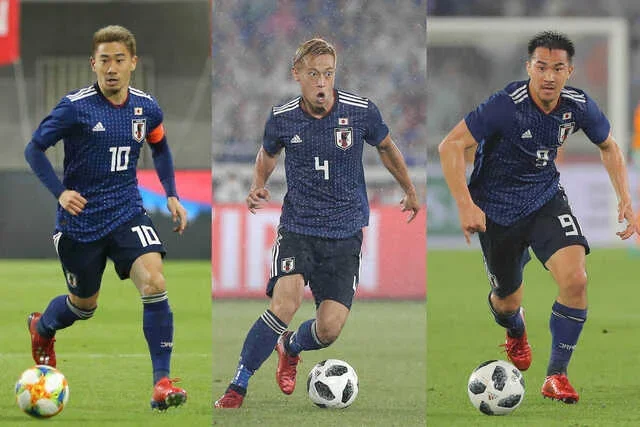
But just six years ago, the story was vastly different. On April 9, 2018, with only 52 days until the tournament, Japan fired coach Vahid Halilhodzic and handed the reins to Akira Nishino. With a stern face, Nishino slowly read out the names of the 23 players selected for the 2018 Russia World Cup. The biggest talking point was the revival of the “Big 3″—Keisuke Honda, Shinji Kagawa, and Shinji Okazaki—all of whom had been sidelined under Halilhodzic’s system for not fitting his tactical approach.
From an initial 26-man squad called up for the May 30 friendly against Ghana, three younger players—Yosuke Ideguchi (21), Kento Misao (22), and Takuma Asano (23)—were cut, while the veteran trio, aged 31, 29, and 32 respectively, made the final 23. The squad’s average age of 28.17 was the oldest in Japan’s last five World Cup campaigns, earning them the nickname “Old Man Japan” (Ossan Japan).
In press conferences, Nishino explained his selection rationale: “We considered overall condition, future potential, and other factors. But the influence of the veterans has put the team in a good place. Younger players must surpass them, but on a big stage like the World Cup, experience is crucial. It’s a tough approach for first-timers on the pitch.” Ultimately, Nishino balanced investment in youth against proven veteran experience, choosing “wisdom of age” for the sake of victory.
Nishino later highlighted two key traits: “rebellious spirit” (hangyokushin) and “rebound mentality.” He noted that all three veterans shared a bitter memory—the 2014 Brazil World Cup, where a supposedly “strongest-ever” Japan failed to win a single match and crashed out in the group stage. Their desire to erase that humiliation drove Nishino’s decision. Both Kagawa and Okazaki were nursing ankle injuries, but their condition was improving, and Nishino deemed them “irreplaceable players.”
Despite the turmoil—a coaching change just two months before the tournament, a rushed selection process, and lackluster friendly results—the team united. They opened Group H with a stunning 2-1 win over Colombia, drew 2-2 with Senegal, and lost 0-1 to Poland, advancing on Fair Play Points after a tiebreaker. In the Round of 16, Japan faced tournament favorites Belgium. Leading 2-0, they were pegged back and eventually lost 3-2 in a heartbreaking counter-attack goal in the final moments—a match now known as the “Rostov Tragedy,” dashing Japan’s first-ever quarterfinal hopes.
When asked what was missing, Nishino mused, “What were we lacking?” The result was agonizingly close, but the gap to the world’s elite was clear. The lessons learned in Russia were passed on to the then-assistant coach Hajime Moriyasu, who now leads Japan in 2026.
**2018 Russia World Cup Squad**
– Goalkeepers: Eiji Kawashima, Shuichi Gonda, Kosuke Nakamura
– Defenders: Naomichi Ueda, Gen Shoji, Yuto Nagatomo, Wataru Endo, Hiroki Sakai, Tomoaki Makino, Hirotake Sakai, Maya Yoshida
– Midfielders: Keisuke Honda, Gaku Shibasaki, Genki Haraguchi, Shinji Kagawa, Takashi Usami, Takashi Inui, Hotaru Yamaguchi, Makoto Hasebe, Ryota Oshima
– Forwards: Shinji Okazaki, Yoshinori Muto, Yuya Osako