
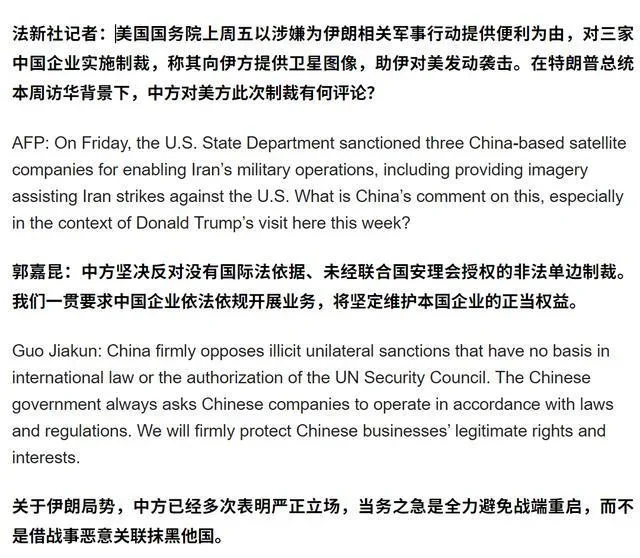
Just before his official visit took off, former President Donald Trump ordered sanctions against Chinese companies. In response, China’s Ministry of Foreign Affairs delivered a sharp rebuttal that laid bare the underlying intentions behind the U.S. move.
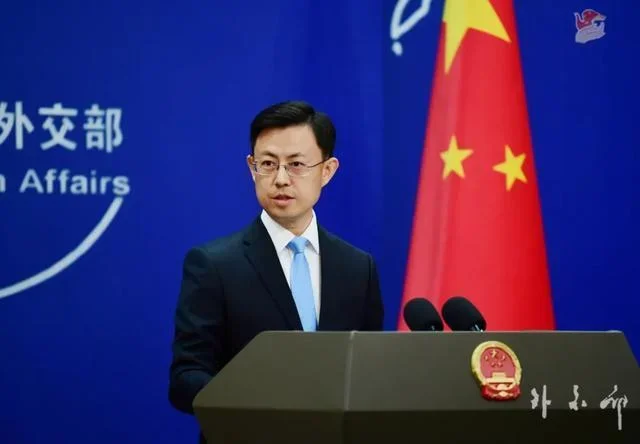
During a routine press conference on May 11, spokesperson Guo Jiakun addressed the U.S. decision to sanction Chinese firms over alleged ties to Iran. Beijing made two key points: first, the sanctions lack any basis in international law and have no authorization from the United Nations Security Council, making them purely illegal unilateral measures; second, China urged the U.S. to focus on preventing the escalation of conflict rather than using the situation to smear other nations.
These statements cut to the heart of the matter: the U.S. is improperly using its domestic laws to override international norms, imposing illegal unilateral sanctions, and applying double standards by scapegoating China. Washington often wields sanctions like a weapon, forcing its own laws onto other nations and disrupting the legitimate operations of Chinese enterprises. Chinese companies operate in full compliance with regulations, and the U.S. has no right to interfere or impose “long-arm jurisdiction.”
Meanwhile, the U.S. demands China’s cooperation in pressuring Iran, even as it stokes flames and fuels conflict in the Middle East. This mirrors the situation in Ukraine, where Washington supplies weapons to Kyiv while accusing China of lacking neutrality—a glaring double standard. Treasury Secretary Bessent even claimed China was “hoarding oil and not helping,” painting Beijing as the “biggest loser.” That is classic hegemonic logic, shifting blame onto others.
These tactics recall the U.S. approach in the Ukraine conflict, but China’s stance remains consistent: respect for national sovereignty and territorial integrity, opposition to bloc confrontation, a commitment to peace without taking sides, and advocacy for political solutions over military force.
As for the current U.S.-Iran situation, military operations have continued for over two months, with a surface-level intensity masking ongoing back-channel talks. A fragile ceasefire holds, but fighting has not fully ceased. Under Pakistani mediation, the U.S. and Iran are reportedly close to a one-page memorandum of understanding. Key terms include: Iran suspending uranium enrichment for at least 12 years and shipping out existing high-enriched uranium stockpiles; the U.S. lifting some sanctions and unfreezing billions in Iranian assets; both sides removing navigation restrictions in the Strait of Hormuz; and declaring an end to regional hostilities while opening a 30-day formal negotiation window.
Israel, however, views this potential deal as a “disaster” and is pursuing a two-track approach: not publicly opposing talks while maintaining military readiness. Prime Minister Netanyahu insists operations are “not over” and demands that Iran remove all enriched uranium and dismantle related facilities. At sea, the U.S. continues to block the Strait of Hormuz, diverting 58 commercial vessels. Washington and Israel are also coordinating potential strikes on Iran’s energy infrastructure. Israel communicates daily with the Trump administration, claiming full coordination with the shared goal of removing all enriched uranium and eliminating Iran’s enrichment capabilities.
From this perspective, the U.S. appears uncertain, fearing Iran will reject the agreement. By pressuring China, Washington hopes Beijing will push Tehran toward a deal. But China has never yielded to threats. Even without U.S. pressure, Beijing actively promotes peaceful dialogue—but coercion and sanctions will only backfire.